Running is a solitary endeavor post collegiately. It doesn’t typically lend itself to a very long shelf life. I am not a professional runner nor will I ever be. I’ve never been the fastest person on my team. I’ve never qualified for a national championship. I’ve never won a race that “mattered”. Running will never be my source of income.
With each passing mile, the voice that was once muted becomes louder. There are no teammates to lean on. No season to look forward to. Priorities change. Running is no longer an acceptable excuse to avoid your responsibilities. Countless hours of training for a seemingly arbitrary number that only makes sense to you. Those winter months trying to regain the feeling in your hands after an easy hour. Those early summer mornings where it’s somehow still over 70 degrees before 6AM. Why do we do this?
There’s no money to be made. Heck you may not even make it to the line in one shape. Your investment in this endeavor is a net loss financially. You’re literally paying money to run now. And for what?
I’ve given a lot of thought about my relationship with running, specifically my choice to dedicate myself to training at a high level again post-college. I, like many others, had a toxic relationship with this sport for much of my career. I’d obsess over let it completely engulf my sense of being and self-worth. Without it I was a wreck. When it wasn’t going well I was a horror to be around. Time away and a shift in priorities have provided me a fresh perspective that has made me a happier person. Running and my mental health are no longer intertwined like they once were. I have a bad run or workout? That’s all it is. It doesn’t ruin my day like it once did. Every day that I’m able to continue to do this is worth it in itself. It’s a hobby. Well I guess hobby would be an understatement if my end goal is to qualify for the trials… But I guess I mean that running is no longer something that has complete control over my life. I dedicate more time to it than more things, outside of my career of course, but it’s under my own terms.
Two weeks ago I raced again for the first time in over a year in a distance that I have not run a personal best in almost 9 years. It was more of time trail than anything. 5 of us on an empty dimly lit indoor track on a random Saturday morning. Everything in the lead up to it was not ideal to say the least. I had an awful night of sleep and awoke with a slight headache. On our drive to the track my buddy has a tire blow out on the highway. By dumb luck I somehow made it to the track. I was completely dehydrated with my only source of water left in my buddy’s car on the side of the road. I stood in the middle of the track nervous and a bit overwhelmed. I was flustered and unprepared.
Then something just clicked, Why are you letting this bother you? This is supposed to be fun, remember?
So I shrugged it off. At this point in a year without major events, there are not many opportunities to race. Why was I going to let myself ruin it because a couple things didn’t go my way. Whether it was a success of not, I was just going to go out there and just enjoy running fast and if things went right, PR.. That’s it, nothing else.
And so it went. I ran without panic. For those 15 minutes, my only concern was the next quarter mile. And the next. And the next. And as I started to labor I found comfort in the realization that I still had that competitive fire, but it manifested itself differently. Instead of ever passing second making me anxious; it brought an almost fun challenge. I was falling off a bit but if I just continued running at my current pace I would just sneak under. The question was just by how much.
This is not how I imagined this would happen when I ran my PR in 2012. For one, that it would take this long, and that it would happen in such an anti-climactic fashion. No crowd. Just a friend with a stopwatch and a couple of us hitting the track hard for no reason other than we had an open track to do it. And in some ways I’m glad it happened that way. As the years went by I’d be lying if I worried that I’d never run any faster. That particular personal best represented a different me, a different point in my life, and I am relieved to finally close that chapter on my own terms.
Running at this point isn’t very flashy anymore. We create small victories for ourselves now. Little highlights that remind us why this is all worth it. And I wouldn’t have it any other way.
It’s not exactly the time I wanted, but 11 seconds faster than my personal best is more than enough to make me happy.
This August will mark 15 years in this crazy endeavor. I remind myself each day that regardless of the result, as long as I continue to have a good relationship with running, it’s worth it to me. And for now I still do.
In order to succeed in this sport you must have the ability to adapt. While we all wish we could just toss our shoes on and instantly run our goal paces on a daily basis, that’s not reality. Nothing about this sport is consistent. You can have the best run of your life one day and struggle the next. It’s the cruelty of the sport.
We adapt by attempting to make everything feel almost second nature. We repeat seemingly endless miles, intervals and drills to prepare ourselves for anything that may happen in a race. In college we would segment courses and utilize race simulation workouts to ensure that on race day we were ready for anything that was thrown at us. The repetition provides you with the confidence necessary to chase that next goal, to push you when things get tough. In a perfect world this would lead to success.
All the simulations in the world can’t control for every variable. Years of racing have taught me that. We’ve all had days where we’ve felt everything was set up to go right; workouts have been going incredible and a goal seemed like an afterthought. Then it happens; things begin to fall apart and you’re forced to make a quick decision, adapt or be left behind. Sometimes you’re lucky and catch that crucial moment of decision, other times you’re caught and left wondering, what the hell happened?
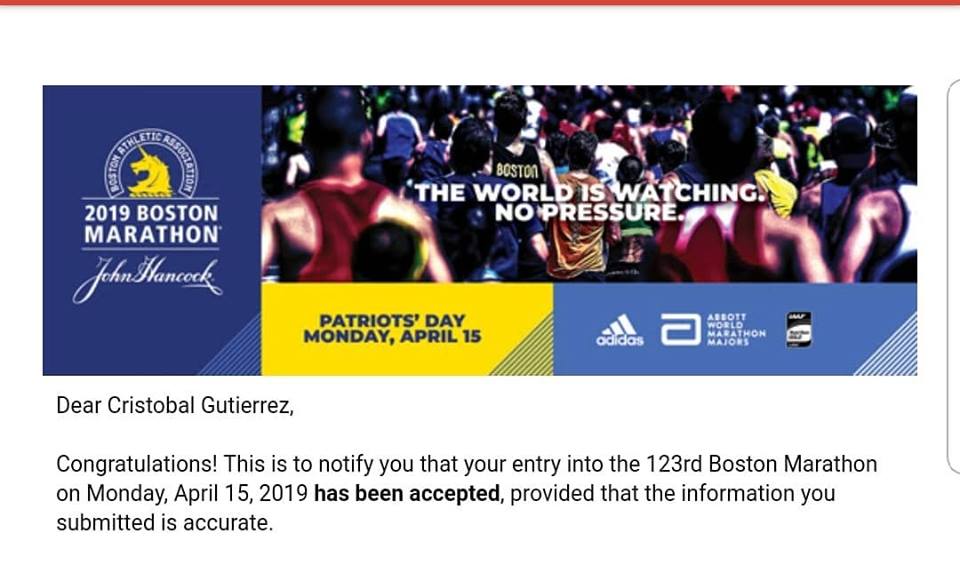
The 2020 Boston Marathon has been my motivation to train for almost the past 12 months. It convinced me to chase the marathon but also broke me. As I stood at mile 22 panting, drinking as much water as I could, I thought to myself, I’ll be back there. Since I crossed that line, that has all I had been thinking about. When runs were rough I was reminded of that moment. When I was sidelined before Columbus I kept Boston in my mind for motivation to stay healthy.
Over the past 3 months I had been working hard to stack up the miles and stay healthy for Boston. I was running some of the strongest workouts of my life and was quickly approaching the end of my buildup; the first time I would have completed one without an extended break due to injury. Pace work was coming across nicely. I was recovering well and I felt like I was ready to redeem myself. As April 20th came closer I was more and more confident. I was ready for whatever Boston could throw at me.
I wasn’t ready for it to be cancelled.
All the training in the world doesn’t prepare you for that. How do you motivate yourself to run the next day when the race you’ve been training for is no longer happening?
The only blessing that a running career full of injuries provides is the understanding that often those goal races won’t happen. I believe that you should level out those peaks and valleys from running as often as you can so that you’re not shaken by anything that could happen. There needs to be something more. A new goal ready to fire as soon as anything happens, good or bad. Whether it’s in training or in the middle of a race, you have to be able to create something for yourself to keep you going. Motivation is much easier to maintain when you’ve become accustomed to having to constantly create your own why.
While many others have completely shut it down following their race cancellations I’ve continued to keep training as though Boston was still scheduled. Instead of training for a peak race coach and I decided to use this as a chance to simulate a full buildup to see what works and if we need to make any adjustments for the next one. A Spring Marathon is not happening but that doesn’t mean that we can’t continue to work so that we’re prepared for whatever the next one throws at us. As the goals change, we create new ones, and celebrate what we’ve accomplished along the way.
Boston may not be happening but today I finished my first full buildup and I’m in the best shape I’ve ever been. I’m celebrating that and I strongly encourage you to celebrate your own accomplishments in this time. Yes we may not be racing but we just came off weeks or months of training in some tough conditions. Celebrate your commitment. Maybe you ran your longest run during this block, heck maybe you’ve decided to start back up again after a long hiatus, celebrate that! Use that as a stepping stone to your next running endeavor.
We can either let this break us or we can use this to make us stronger. All of our races are cancelled, yes, but we’re all in this together. No matter what level we are at, we’re all in the same boat right now. Use this time to go back to your why or even just to create your why. Look long term at what you want to get out of this for yourself so that when you finish your next race you’re not wondering what’s next or feeling that post race comedown that many of us feel after a big accomplishment. Take advantage of the online community of runners and talk to each other. Eventually we’ll be all back on the start line. Until then, let’s adapt and move forward.
This has to be a theme with the relationship between me and this distance.
Boston changed a lot for me. I ran pretty well despite spending the majority of my buildup sidelined. I felt that I could get myself under 2:30 on my own; I would continue to work on base and try to stay injury free. But Boston made me wonder, what else can I possibly do? I was still so new to this distance and had no experience creating training plans for the marathon. What could I do under a structured plan?
Thankfully I didn’t have to go too far with my search. My buddy Zach Ornelas had been providing me tips for my first two marathons and after inquiring about who coached him, he offered to coach me. I didn’t hesitate to accept. An Olympic Trials Marathon Qualifier, an absolute monster on the trail scene, and success coaching his own athletes? Easy choice. I had complete confidence he would take my training to the next level.
The road to Columbus began in July. For the first time in years I had a consistent month of training in July. I was stacking up the mileage, but unlike my buildup to Boston, I was consistently running workouts and tapping into some faster stuff. I followed every single day to a tee. 5:00 AM, sometimes an hour with some pickups, other times 3 to 4 mile tempo with hill sprints. I’d have anywhere between 10 to almost 15 miles in before I started work. I ended July with one of the highest months of my running career with 335 miles logged in the bank. I won my local 5k for the third year in a row more than 30 seconds faster than I’ve ever run it during an 80+ mile week. I was fit and things were going well!
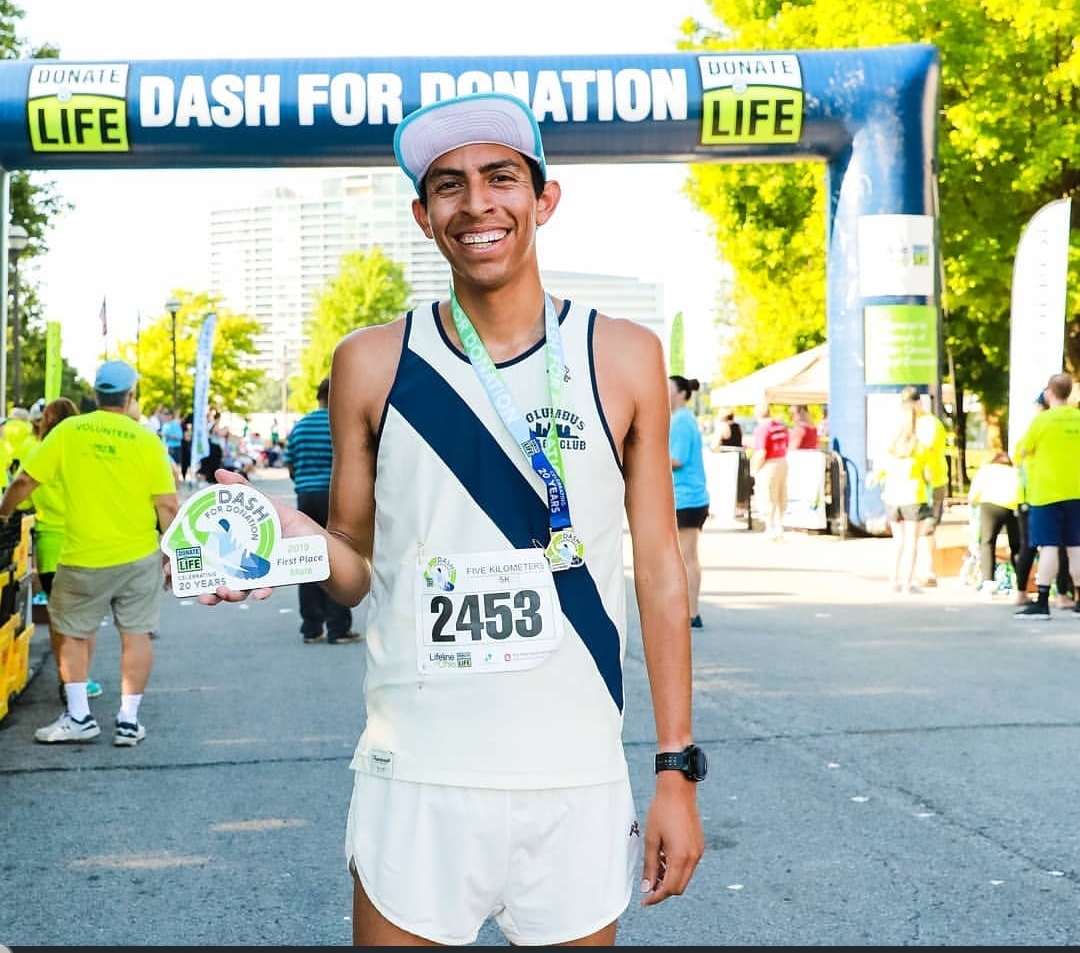
Easy win with a 4:56 last mile.
Then it stopped going well. I had my first half marathon scheduled for the 3rd week of August with the plan of running a negative split and making marathon pace feel pretty easy. Two weeks leading up to the race I started developing shin issues. What started with the usual aches and pains after a workout turned unbearable pretty quickly. I found myself having trouble just walking without my shins pulsating. Something was wrong and I feared I may have developed a stress reaction. Zach and I decided to shut it down, pull out of the half marathon and focus on easy running and getting healthy. It was a tough choice but he helped keep it in perspective; shut it down now and save myself from a stress fracture and being out completely. It’s exactly what I needed.
August consisted of rehab and easy mileage in an effort to salvage this buildup. Thankfully I didn’t have a stress reaction or stress fracture. Regardless, I was getting nervous. Time was ticking and before I knew it I would be on the start line. By the end of August I had logged 164 miles, a long way from the 335 I ran in July. But I was healthy and we still had time.
September saw some consistency back in my running. I was pretty hesitant but Zach kept my head on straight. We didn’t lose that much time. We would adjust our training program and focus on trying to get to Columbus healthy. Nothing crazy, no hardcore workouts, just focusing on getting the miles in and we’d add some pace work once we felt we were ready.
I got back to business quicker than I expected. Within two weeks back I found myself clicking off sub 6 pace pretty easy at the end of a 14 miler. 14 miles was a long way from 26.2 and I had to keep reminding myself to keep myself in control. Our goal was to get to Columbus healthy. The stretch to Columbus went by without any issues. Two weeks out from Columbus I ran my last major workout, a long run with odds and evens, jumping from marathon pace to one minute slower than marathon pace. I crushed it. I ran the first 10K easy and proceeded to click off the miles. 5:31, 6:31, 5:29, 6:28, 5:29, 6:26, 5:26, 6:18. I was ready to PR. But by how much?
Race day had finally arrived. I cleared through an easy tune-up Thursday and kept things easy for the days prior. I had no idea what to expect. I did have a couple workouts in the bank that had my confidence high but nothing to gauge what pace I should be going for. We decided that the goal was to negative split this one. We’d take a controlled approach for about 10, start making some moves for the next 10 and try to run people into the ground over the final 10K. 2:30 was on my mind and I was a bit nervous to take this strategy. I’d be leaving a lot of time on the table for that first half and banking on feeling great.
I arrived to the Elite tent at about before 6AM. My bottles were ready to go for each of my stops and I packed an extra GU just in case something went wrong. I felt good, no aches or pains. I was healthy and ready to see what I could do. There was nothing more I could do at this point. I just thought to myself, time to send it.
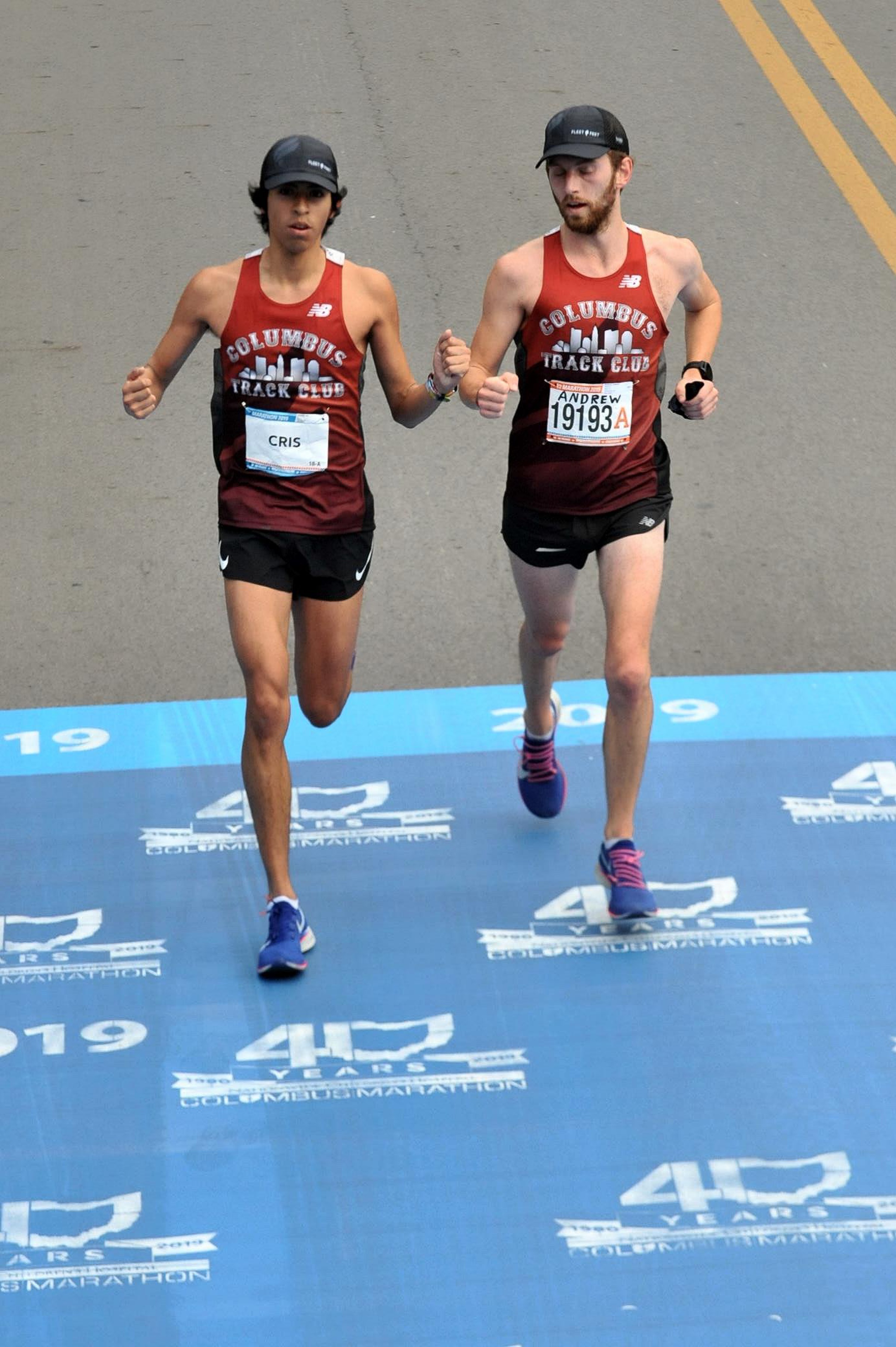
A rope separated the elite section from the main corrals for both the half and full marathon. As I started getting my final strides in I heard a familiar voice. My Columbus Track Club teammate, Andrew, was right at the front, ready to help pace me through the first half.
After those final strides we were instructed to line up. I put myself behind everyone in the elite corral. My race would not be made in those first couple of miles but it sure as hell could be lost there. The race was off and I found myself lost through the pack trying to find my teammate. Within a quarter mile we had grouped and it was time to execute the first phase of my race plan. My body had other plans. Within that first mile I already had the urge to use the bathroom. How long would I hold? Well it wasn’t long. By mile 3 I had to pull to the first port-a-potty I could find, each second feeling like I was there forever. I bolted out and saw Andrew not too far ahead, slowing down enough for me to catch him without having to sprint. It was a 5:59 mile, so not too much time was lost there. Andrew calmed me down and we got back to business.
The next couple miles consisted of checking in with each other every mile and Andrew being the absolute best pacer possible. He let me have the inside line on every turn, took my water bottle when I needed it, and spent the entirety of the first half just having fun and helping keep my nerves down. With the race including both marathoners and half marathoners it was tough to have a gauge on how I was doing. All I could focus on was myself.
Alright Wallace, one, two, three, fist bump!
At mile 8 I began to get antsy. I started seeing people start to come back to me and I yelled out to Andrew They’re coming back to me, they’re fucking coming back to me! Andrew quickly reminded me that we still had 18 to go but I figured it may be time to make a decision, start moving at 10 or wait a bit. The next two miles seemed to breeze by and I had started dipping into the 5:30s. Despite feeling good, I figured I was getting a bit too trigger happy. We decided to dial it back to 5:45s and stay consistent for the remainder of our time together.
Before long it was time for us to split. Andrew gave me his well wishes, reminded me to stay relaxed, and made his way to the half marathon finish. The race had officially started and I was on my own.
The next 5 miles proceeded to be the fastest consecutive stretch of my race. I found myself running through familiar territory. Every street that I turned on was one that I had been running on for the last couple of years through the various run clubs I’ve been a part of. I started seeing people come back to me, little by little.
Shortly after the halfway mark I had realized that in my excitement I had completely missed my water bottle and GU. No worries, I had packed one just in case. I pulled it out of my back pocket and went to open it.
Only for it to slip out of my hand…
I wasn’t going back for it. I wasn’t going to lose more time at this point.
We kept going, clicking off 5:30 mids up to campus. At about mile 16 there were volunteers handing out nutrition. Perfect I thought, we’ll make up for that missed stop at 12. I grabbed a GU only to hear a volunteer yell out that my bottle was up ahead. Perfect, not going to need this, I thought, and I tossed the GU. I ran by the table and grabbed a bottle.
Only to find that it wasn’t mine.
I dashed back and put it back on the table and probably looked like a madman trying to find my bottle.
It was gone. Someone had taken my water bottle.
Dude, don’t worry about it. Go!
I almost lost it there yelling, Where the hell is my water bottle!?
I realized quickly that there was nothing I could do at that point so I kept going. The next couple miles I ran scared. I was in new territory and I was quickly losing fuel. I felt like a nervous wreck as I approached each mile. The longer I went the more risk I was taking. Water would be the only type of fuel I could take at the moment at least until mile 22. I was gaining on people. Somehow this was going well.
In what I could only assume was a state of delusion I began to think the current state of my race as a Formula 1 strategy. I was on a hard tire strategy. We’d be pitting later and be switching to soft tires at mile 22 to run down the stragglers.
That helped, and oh boy did I need that help as the hardest part of the course was to come.
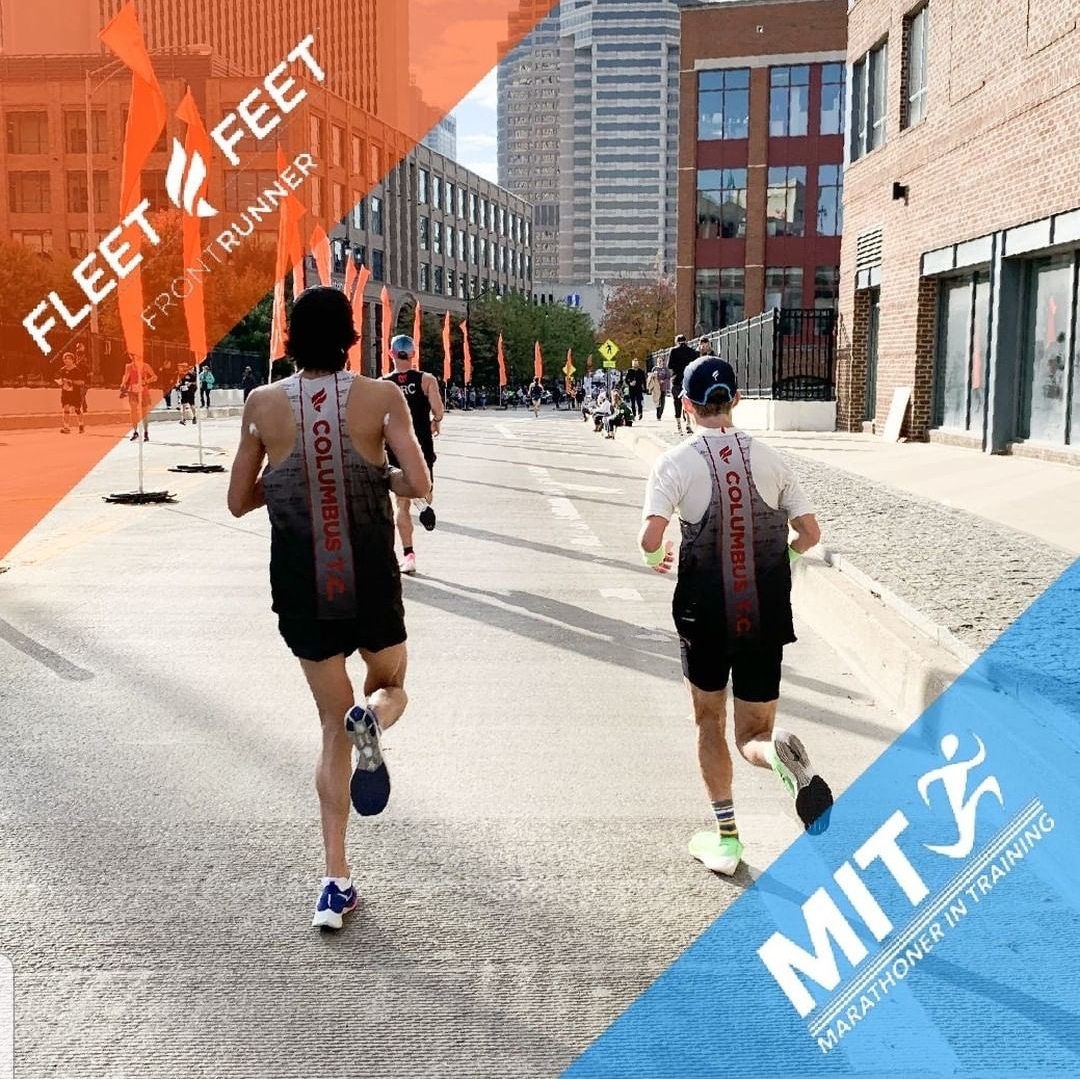
The turn onto Lane Avenue was a route that I had run countless times but on this occasion it almost broke me. I was slowing quickly as I was cresting but just as I felt I was going to break I heard familiar voices. The Fleet Feet crew was yelling at me to keep moving. I was making quick ground on the next couple groups. They were all coming back to me but I would need to keep pressing. I had almost started running in the 6’s and I had a decision to make, go now or be broken.
The next couple miles took me through my neighborhood. As it began to hurt, I would ease the pain by reminding myself that I had worked out there before. If there was anywhere to die it sure as hell wouldn’t be in my backyard. I was back in the 5:40’s and mile 22 was coming soon. I would have a long overdue hit of GU and it would be time to make my final move for home.
Thankfully the final water stop came without incident. A friend had yelled out that I was 16th and I still had some guys within eyesight. Just around the water stop I saw one guy pulled over. I figured he was number 16. Keep moving. Keep moving. Another two were up next. Originally we had been running as a group before I hit the port-a-potty. I figured within one more mile I had them. Sure enough the mile passed and I pressed the gas hard, pushing past both. A 5:37 mile at mile 23.
15th, 14th, okay, okay.
We were now in familiar territory. A little more than 5K and I’d be done with this. My body was aching and I was beginning to feel heavy. Every couple minutes I’d have my teammate Evan biking by shouting out encouragement that would take me out of it. I was hurting but I’d come way too far to break over just over 3 miles. Within no one to see over the next mile my pace slowed a bit but it would not be for long. Running toward the 25th mile I started seeing a familiar face run back towards me. He had taken a wrong turn! Just ahead of him were another two!
My legs were burning. I was struggling to keep my form in check. Just then another bike came right by me. Jeff, who I paced at the Cap City Half Marathon was returning the favor. I kept my head up and made the push for home. As the crowd started getting bigger my legs started feeling lighter. A 5:56 25th mile became a 5:25 26th mile. I bolted past the three, 13th, 12th, 11th. I didn’t see anyone else ahead of me. It was my position to lose and I’d be damned if I lost it in the last quarter mile of this race. I ran my ass off for the last .2, bringing it down even faster to 5:05 pace.
Less than a mile to home.
After 26.2 miles I crossed the finish line, 2:30:25 and what I thought was an 11th place finish. I didn’t finish top 10 but I was so proud of my performance. I ran a 4+ minute PR off of broken build up. I did it!
Little did I know I was a bit off from where I thought I finished. Zach immediately texted me my result. I wasn’t 11th, I was 6th! Not only did I PR but I would be taking home money too! My finish brought me $500 for the 3rd Ohio finisher.
Over a month later I still can’t believe it. At the end of the day I credit this to my coach being patient with my training and adjusting to the setbacks that I faced in August. I thought Boston was going to be the most memorable running experience of 2019 but it’s hard to beat running well in front of your friends and family. My dad drove 10 hours from South Carolina to watch me race for the first time since undergrad. My Columbus Track Club teammates were all throughout the course and my coaches from Tiffin even made it out. While Columbus may not have been perfect it tested me and taught me the mental strength that I will need if I want to take this to the next level. It brought a new goal for myself:
We are not in love with running. We are in love with running well.
We don’t voluntarily get up every day to suffer. we don’t use running as a form of cardio. We identify ourselves as runners; whether we are those that just enjoy training or that do this to race. We keep doing this because there is something enjoyable about putting one foot in front of the other for miles.
With that said, I’ll repeat, We are not in love with running. We are in love with running well.
Our fascination and at times obsession with it comes from us trying to better ourselves, pushing ourselves further and faster, testing the limitations of our bodies. We post about great workouts, hang medals on our walls with pride, but what happens when it all seems to be going backward. What happens when you’re caught in a slump?
We’re in a particularly hot and humid summer here in Ohio. The low in the early hours is a cool 75 degrees. It’s muggy and it’s hard to enjoy running. While we may have prayed for summer to come quickly when we were struggling through negative temps in the winter, a couple weeks of this have really made us miss freezing. I’m constantly surprised at how my Strava feed finds new creative ways to say that this weather feels like complete hell.
As entertaining as reading those captions and descriptions are, I’ve also seen some questioning their fitness and motivation. I get it. Another day, another run that is a ton harder than it was months ago. The good days start becoming rare, and you start question why you’re out there at all. It becomes hard to get out the door when you know the next hour will be filled with you feeling like you’re going to pass out from an “easy effort”.
We romanticize running. We keep ourselves going because of our memories of great workouts, races or memorable runs. We forget those terrible blocks of time. Let’s be honest with ourselves here, running sucks most of the time. There’s absolutely nothing fun about struggling through an easy run after a race with your muscles screaming at you. If it was 55 degrees every day and we could never feel sore we’d have no reason to not love this.
But it’s not. For the next couple months we have to fight through what seems like an endless muggy path to the next season. It’s hot, it’s humid, it sucks, but it sucks for all of us. The heat and humidity will affect your pace. There’s articles all across the web that talk about this (like this). There’s a reason that prime temperatures for a marathon are under 50 degrees, the heat makes the body work harder to try and keep it cool. Add in humidity and we have the elements really working against us. You’re not losing fitness, you’re not going backwards, it’s just hot.
We have a long summer ahead of us. When I was coaching, the two things we worked on was trying to stay healthy and avoiding mental fatigue. We tend to be very impatient when it comes to training. We jump into workouts quickly, excited for the fall and wanting to get fit now. I held my guys back all summer, slowing their tempos and regular run paces, just focusing on getting the miles in and dedicating at least twice a week to run with others. The excitement of summer training fades pretty quickly and I wanted them to stay hungry. Running was going to be hard no matter how fit they were. The goal was to was to stay hungry and keep themselves fresh.
And that’s the key here. While their peers found their motivation wavering and fatigue settling in by mid July, they continued to press forward because they were not exhausted mentally or physically. They made it through the summer training running 80 miles per week without injury and hungry to run fast. Both PR’d that season. I remember back in college when I could barely knock out 5 mile tempos at 5:45 pace during the summer only for months later to finish 5 at 5:08 pace. Keep focused, stay patient, and stay hungry. Take care of your body, get a group together to get through the long days, and find ways to motivate yourself. It’s easy to be excited about running when it’s nice out and you’re running well. These are those moments that will test you and eventually make you a stronger runner.
I say it often, summer is all about survival. Get out there and run the miles, focus on effort and keeping yourself fresh. We’re all out there suffering, but you’ll thank yourself in the fall when you’re crossing the finish line.
Prologue: My original plan was to have two separate posts for this. I was going to do a pre-marathon post reflecting on my build-up and then a recap. Below is an excerpt of what I wrote on the plane to Boston on Friday morning:
If you were to tell me a year ago I would be running my first Boston Marathon I’d probably laugh at you. The thought of running a marathon or even two for that matter was outrageous. I never considered myself a marathoner nor did I have any desire to join that group. Yet here I am, on a flight to Boston looking to PR in a distance that is still uncharted territory. With three days until Boston it’s as good time as ever to reflect on this build up.
The road here has been both some of the best and worst experiences of my running career. I spent the majority of this training block grinding through aches and pains in an obsession to reach 100 miles healthy. That 7 week block of training was the most consistent I’ve ever been with my running and showed me just what I can do when I put my mind to it. Chasing those miles brought me back to enjoying running for the first time since my last season at Tiffin. I was 3 days out before my Achilles let me know it was time to take a break. I spent the next month aggressively rehabbing in an attempt to hopefully make it to the line pain free. At some points during that time I was terrified that I may have damaged it to the point where I’d have to spend significant time off, no Boston, no running. The last month has been a roller coaster of emotions, from wondering if I was going to be able to even finish to now creating a race plan for a big PR with at least some confidence to go after my original goal: 2:29.59. Somehow with 3 weeks out, through consistent rehab and the help from the staff at Fit For Life I’ve been able to turn things around. I’m healthy and it’s such a relief to be able to type that out. The weather may not be looking great at this point but I’m still going to fight. I just have to remember, I came here to race, not to just finish.
Soon after I wrote that sentence we had to prepare for landing and I had to put my laptop away. I would get to it later that weekend (as you can see that didn’t happen).
I had a very different Boston weekend than most. Instead of touring the city and exploring the various marathon weekend festivities, I, in typical Cris fashion, took a 7 hour excursion through Vermont and Maine visiting indulging in seafood and bucket list breweries. This meant that I ended up not running on both Friday and Saturday, the first due to the road trip and the second because I ended up sleeping in after a wild night out in Portland. Not really the most responsible thing to do before a big race but I’ve found that these trips take the nerves off of me. I’m already fit, the last thing I need is to be nervous. I was already nervous for Boston, mostly due to the last 7 weeks of almost no down mileage and rehab to get to the line healthy. The last thing I needed was to have my whole weekend be me thinking about it. The beer trip served as a much needed vacation before it was time to get to business.
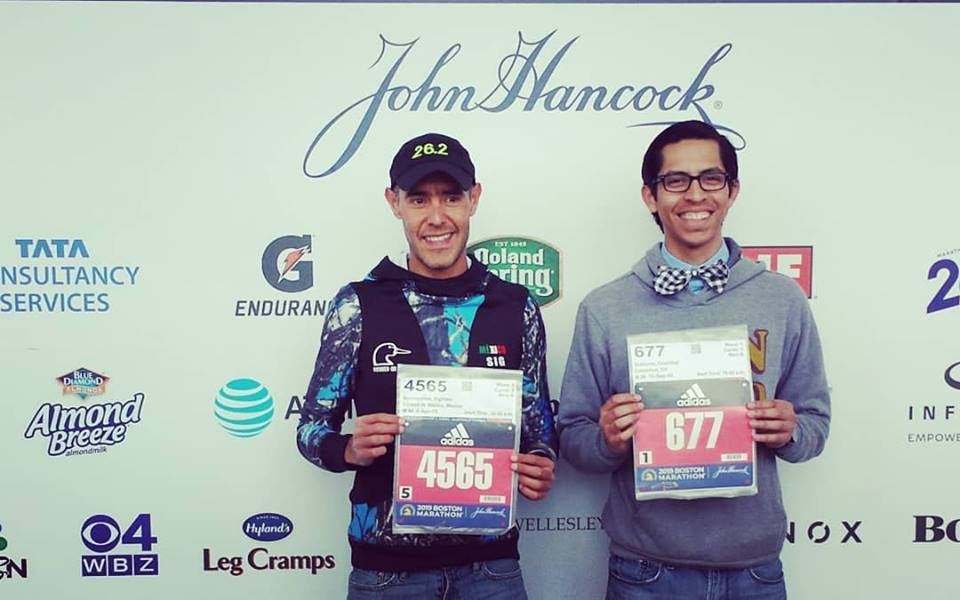
I also had the opportunity to meet an awesome fellow from Mexico, Sigfrido. Through my Boston posts on Instagram we ended up following each other. He shot me a message the week leading up asking me what my plans were for packet pickup and that he was looking for some help navigating through the city as it was his first time at Boston. By some chance we were in the same hotel and I let him know I’d be happy to take him along with us to get our packets together and get to the race. I’ve had so many people help me out in my travels throughout the country; I felt like this was a great way to finally pay it forward. Plus, any time I get to practice my Spanish is always a plus!
I started my Sunday with a short shakeout from the hotel. Despite getting to bed early, I felt incredibly groggy and tight. My last mile was 6:40 and it didn’t feel all that great. I kept thinking to myself, I want to run almost a minute faster than this tomorrow? I brushed it off, I’ve had rough shakeouts before and on the bright side my Achilles was completely healed. The last couple weeks of rehab and easy running had proved to be just what I needed to get to Boston healthy.
While physically it was not a great day, mentally Sunday was a cathartic experience. I toured the city with my family and Sig, picking up our packets and checking out the finish area. The energy surrounding the finish area made me excited to be there. This was a much bigger deal than I thought it to be. Everywhere I looked I saw people in Boston jackets. The city was filled with runners from across the world all here to toe the line and try and conquer Boston. The atmosphere was so positive and welcoming, we all made it here one way or another, and it was as though we all were in this together. Sunday made me proud of the work I did to get here despite the setbacks. I made it here and there was nothing I could do to make me any better. One foot in front of the other for 26.2 and if I was meant to run fast I would. At this point I had done everything I could do given the circumstances. I went from almost reaching 100 miles a week to spending the last 7 weeks averaging less than 30 miles per week.
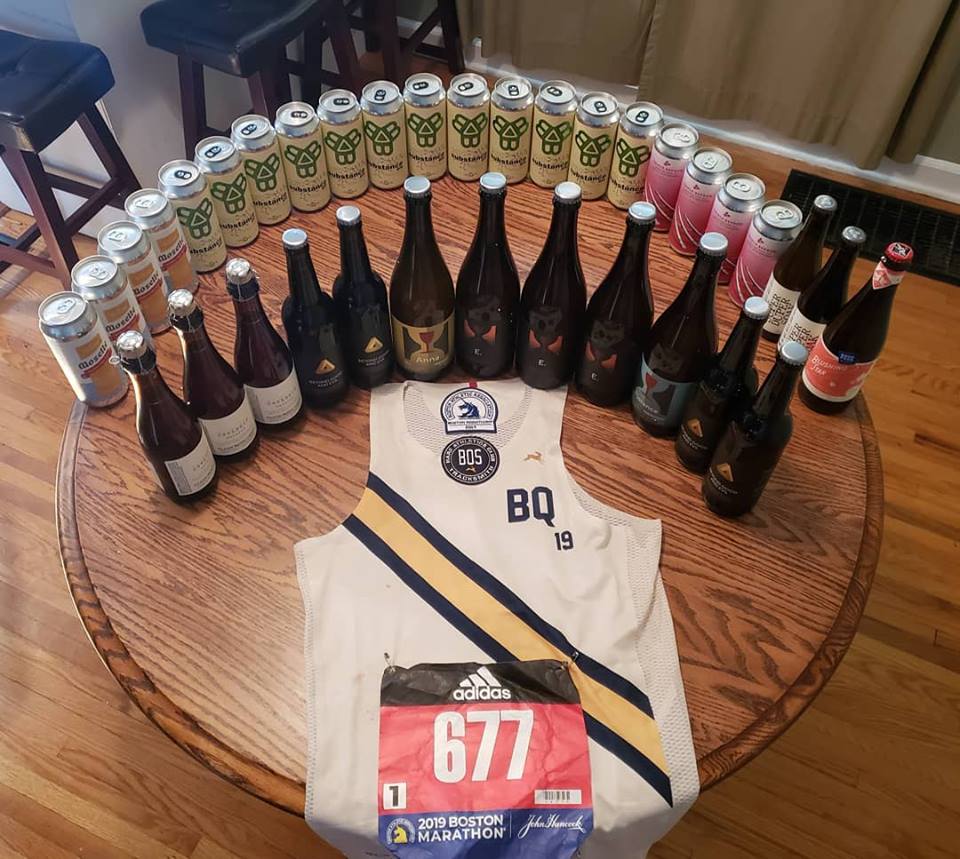
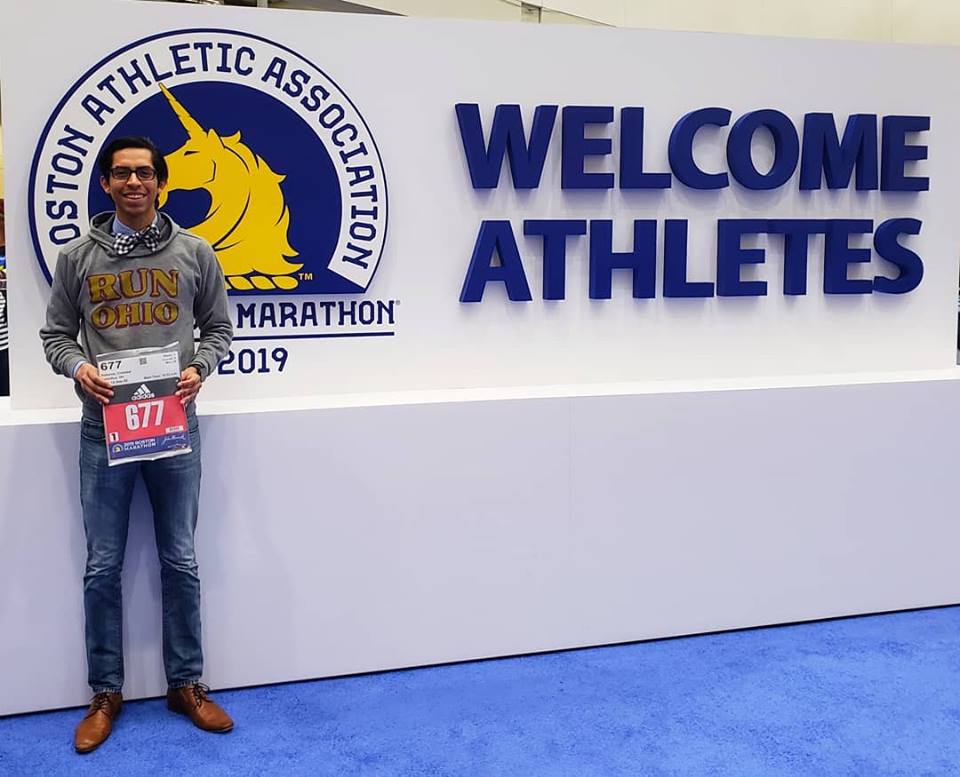
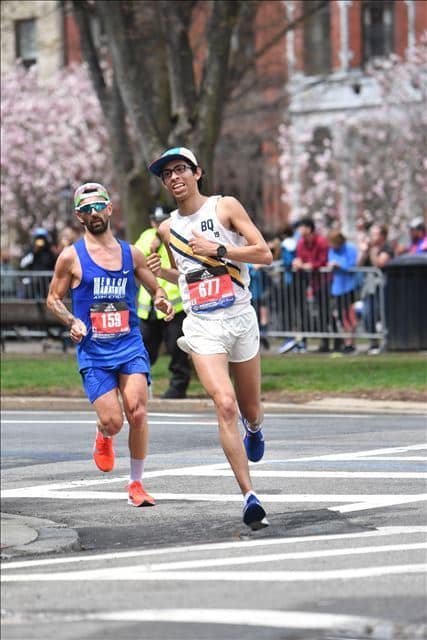
#677, how close to that would I finish?
I had no race plan besides just focusing on effort. My buddy Zach had called me Friday night with tips on how to tackle Boston: Hold back for 10 miles and not get too excited with the downhill. Once the route levels out, move, maintain up Newton, then crush the finish. He warned me multiple times, go out too fast and the last half will break you. The excitement of the crowds will make you want to go, be patient. He had negative split this before and run low 2:20s. It was possible to run fast here if you didn’t do anything stupid.
Monday I awoke still not feeling great. I had trouble sleeping and wasn’t feeling my bouncy self. In all honesty, this was probably the worst I’ve felt before a big race. It was a complete 180 from Erie where I felt I was ready to kill. I tried turning on my I-Pod Shuffle to get me focused. Dead. Looks like I wasn’t going to need that during my race. My intention was to have it ready for the second half, put the headphones on and block out the pain and focus. I was a bit thrown off; this was really how my day was going to go.
Getting to the start line felt like a mission in itself. Rain smacked us as we made our way to the bag check and on our way out to Hopkinton. As we came closer and closer to race time, the rain seemed to not let up. It seemed like we were in for another 2018 but with warmer temps. The forecast called for the rain to clear just before race time and I crossed my fingers it would hold true. I came prepared for the rain and mud in the athlete village. I wore some old sweats over my racing kit and kept my racing shoes in a plastic bag to avoid them from getting wet or muddy. I would keep all of this on for as long as I could and once we got away from the mud pit I would ditch the old clothes and head to the start line dry and ready to go.
With about 45 minutes to go the rain finally cleared. What was left was a light breeze. We all moved our way to our corrals trying our best to get some type of semblance of a warm-up routine. It was a bit of chaos getting to the line with people trying to get some jogging in, some trying to find a way to sneak a last bathroom spot out of sight to avoid the long lines, and others just taking their time walking, looking as though the rest of us were crazy. Rookies, they probably thought.
After somehow making time for two more bathroom breaks, I finally arrived at my corral, Wave 1, Corral 1. We would let the elites go out first and two minutes later it would be our time to tackle Boston. Two minutes out, bang, the elites are now off. The next 120 seconds felt like time slowed to a standstill. We all stood there, antsy, just waiting for those seconds to click off and we can finally make our journey toward Boylston.
I can’t say I remember much about the start of this race. I just remember running, trying to force myself to slow down. The downhill was a bit of a shock to my system to start, definitely did not expect it to start like this. And oh, an uphill? I really should have done my homework a bit more, I thought to myself. My first mile was a bit slower than I wanted it to be but I didn’t let myself be too bothered by it. I’ll take a 6:07 first mile now if it meant I didn’t crash and burn in the second half. I was ahead of pace from my marathon PR already so there was worse things that could happen. As runners around me began to settle into their pace I began to get into rhythm, moving by groups rather quickly. My pace dropped pretty significantly to a 5:47 and it felt easy. I made a decision then that I would not focus too much on my pace. I would monitor my breathing and my effort and take a glance at each mile just to see where I was at. I settled in, sticking with packs and moving forward, the beep of my watch my guide as I moved forward. The crowd was incredible, people lining both sides of the streets loud as could be, cheering on strangers as they passed. It was easy to get caught up in the hype, but I remained controlled, focusing more on my position. The goal now was not to lose position, just gradually move forward. The goal was now to try and negative split.
Real early, moving up.
Going through Wellesley I got a little too excited. Unlike in Erie when I was just focused on blocking out the race, I got into the crowd and started having fun with it. I would raise my hands and encourage people to cheer, give high fives to people on the sides, and look for people I knew. After seeing my family right before the Wellesley Scream Tunnel, the pace started to drop into the 5:30s. Luckily I caught it before I went too long here, while the downhill was over, we still had the hard part to go.
Wellesley Scream Tunnel, rockin’ and rollin’
And this is when the wheels started to fall off.
I maintained steady through 16. I had crossed the half at 5:47 pace and was going to work on the hills and try and average 5:30’s for the miles following heartbreak. As I came down the final steep downhill at 15 I began to start feeling something off. My hamstring had started to tighten up, most likely due to the first couple miles adjusting my stride for the downhill sections. As I saw the Newton sign the race had changed and it seemed like the crowd atmosphere had too. Whereas the first 10 miles seemed to be a celebration of the accomplishment of being there, the second half of this race were more people trying to motivate runners as they tried to survive the second half. The runner’s faces of joy had become grimaces, the discomfort of the beating downhill section now starting to settle in. With the crosswind now gone, the reality of the warmer temperatures had also now begun to take their toll. The crosswind masked the heat, leading me to not hydrate as much as I should have in the early miles. Now making my climb up the Newton Hills, signs of thirst became apparent. I took small drinks through to try and satisfy that feeling and kept moving. The pace had slowed but I expected that with these hills. I would make sure to keep it under 6:00 and then as soon as I crested Heartbreak the dash for home would begin.
The hilly section of the course wasn’t all that terrible. The hills themselves were gradual and your legs definitely felt it but it wasn’t anything close to the mountains back in California. What made this tough was that my legs were already beat by the downhill. My hamstring tightness had now begun to impede my running form a bit, my muscles now shooting small sharp pains as each foot hit the ground, but I pushed forward and finally made it to heartbreak. After seeing the top of the hill for what felt like forever, I finally crested it. I had skipped GU at 20 thinking that I was close enough where I wouldn’t need it. I tried dropping the pace after cresting heartbreak but I couldn’t move. I felt stuck, tight, and lightheaded. I kept trying to fight the negative feelings and block out the pain and I got myself back under 6:00 for the next mile.
As I inched closer and closer to mile 22 my form broke down and I began to crash. As I passed the water stop at 22 I made a decision, I had to stop. At the last table I came to a complete stop and asked the volunteer for water. I drank as much water as I could and took my last GU. Overwhelming emotion came over me, I felt like I was quitting, but almost instantly as that thought came into my head I took my last cup of water and got back out there. I didn’t travel this far out for my race to go to crap in the last 4 miles. Mile 23 with that stop was a 6:42.
The last 4.2 miles of that race were some of the hardest running moments of my life. My feet had begun to start burning and my muscles were aching but I kept fighting to try to get my pace close to where it was before I crashed. I began to count down the time in my head, 25 minutes, 19, minutes, etc… After all that work I had put in the winter I could survive another couple minutes of discomfort. As I arrived into the craziness of the city I made one last effort to finish strong. With one mile to go I pushed hard, I could see the clock, 2:33:00. I couldn’t believe it. I didn’t lose all that much time and if there was a chance I could get under 2:35. I sprinted, I sprinted as hard as these legs could take me and I crossed the line, 2:34:46, 193rd overall and the top finisher from Ohio. My body hated me and I could barely walk but I finished my second marathon with a big PR.
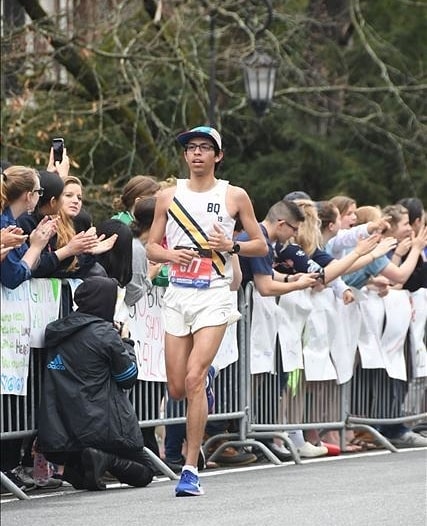
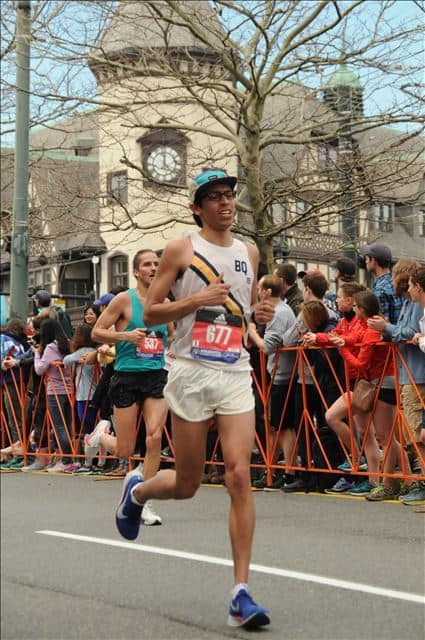
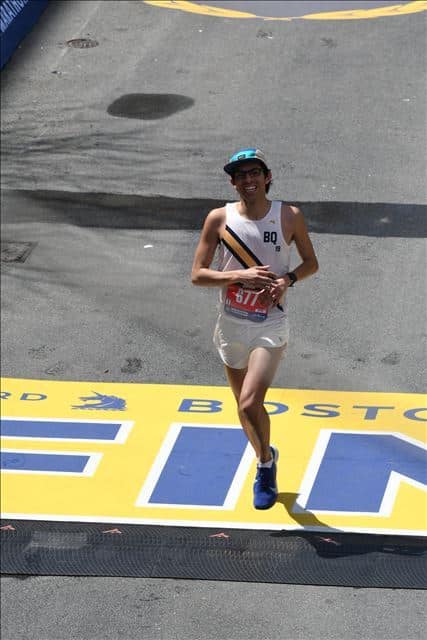
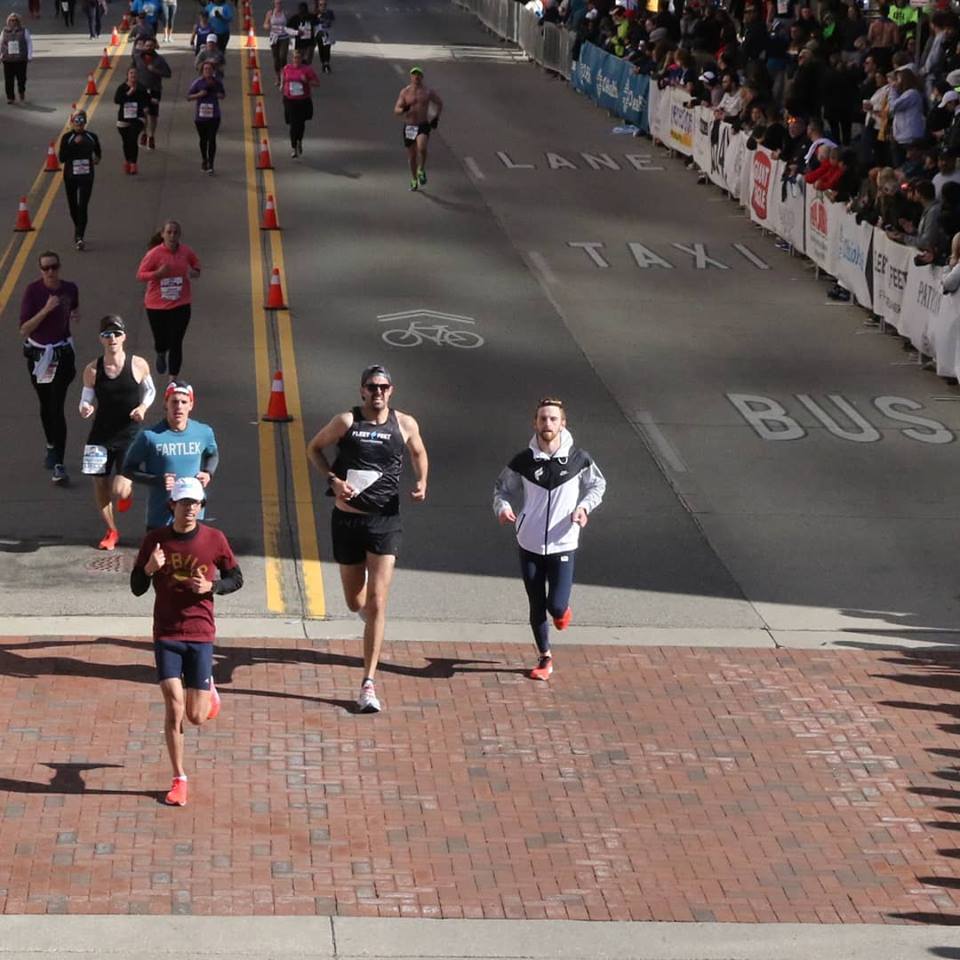
Rounding those last couple turns.
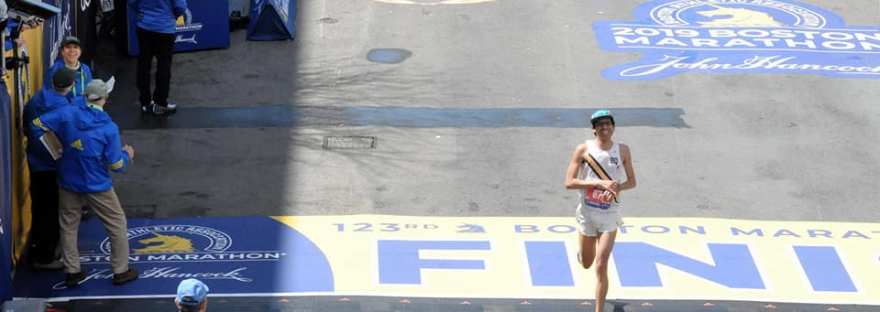
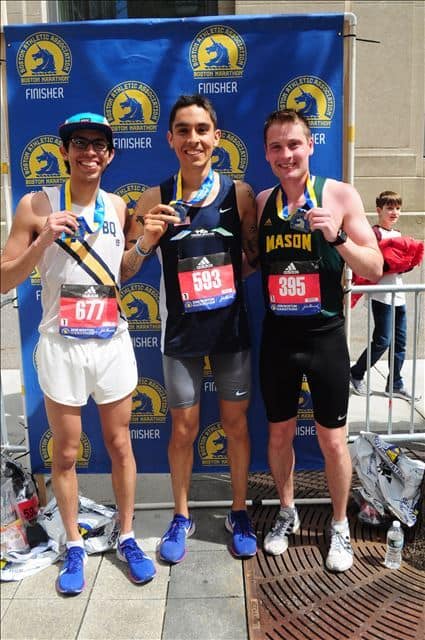
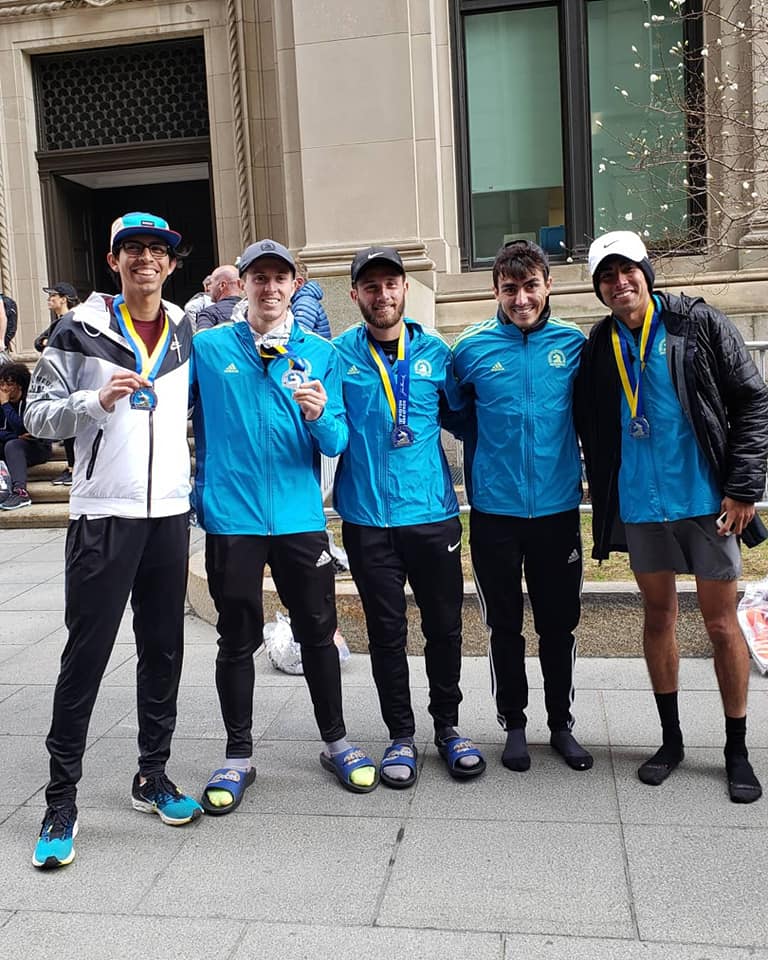
Officially a Boston Marathon Finisher.
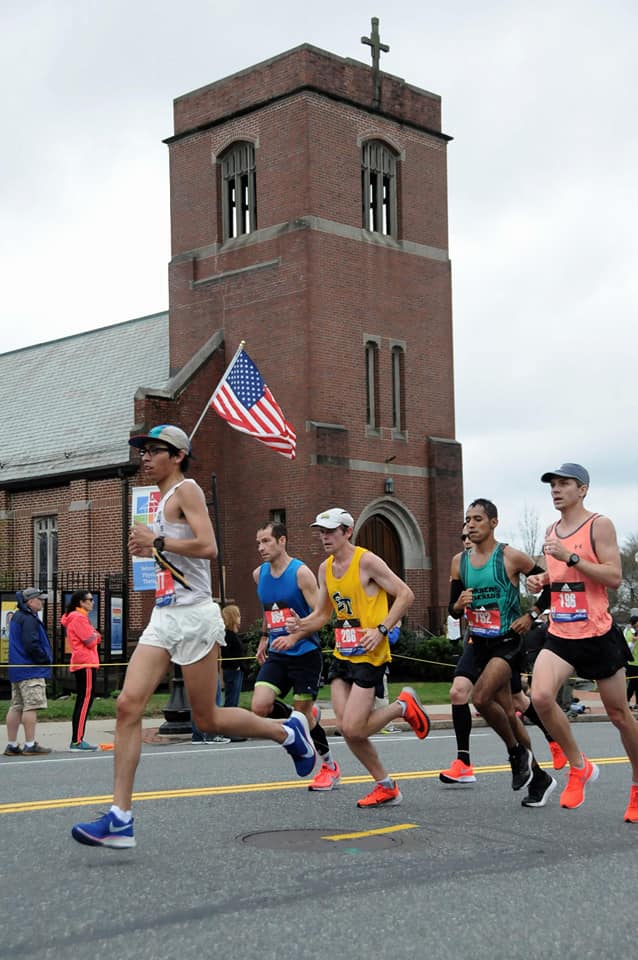
These guys helped me move through those hills.
With a month and a half since Boston, I’ve had a chance to really think about my performance. I’m not completely satisfied with being a 2:34 marathoner but considering what my buildup was I’m proud that I was able to run that. I really shouldn’t have been able to run like I did with those last 8 weeks of training. This race humbled me a ton and changed me as a runner. The support I received during and after the race was overwhelming. So many people reached out to me and congratulated me for the performance and it’s now become one of the most proud moments I’ve had as a runner. This journey introduced me to a new community of runners and helped me get more involved in the Columbus running community. Big shout out to Fleet Feet/Front Runner, Columbus Track Club, Hoof Hearted, Zach, and Fit for Life Physical Therapy. Without the help and support of them I wouldn’t have gotten this far. Also shout out to my mom and brother for coming out short notice to surprise me. Seriously guys, that made this trip even more memorable.
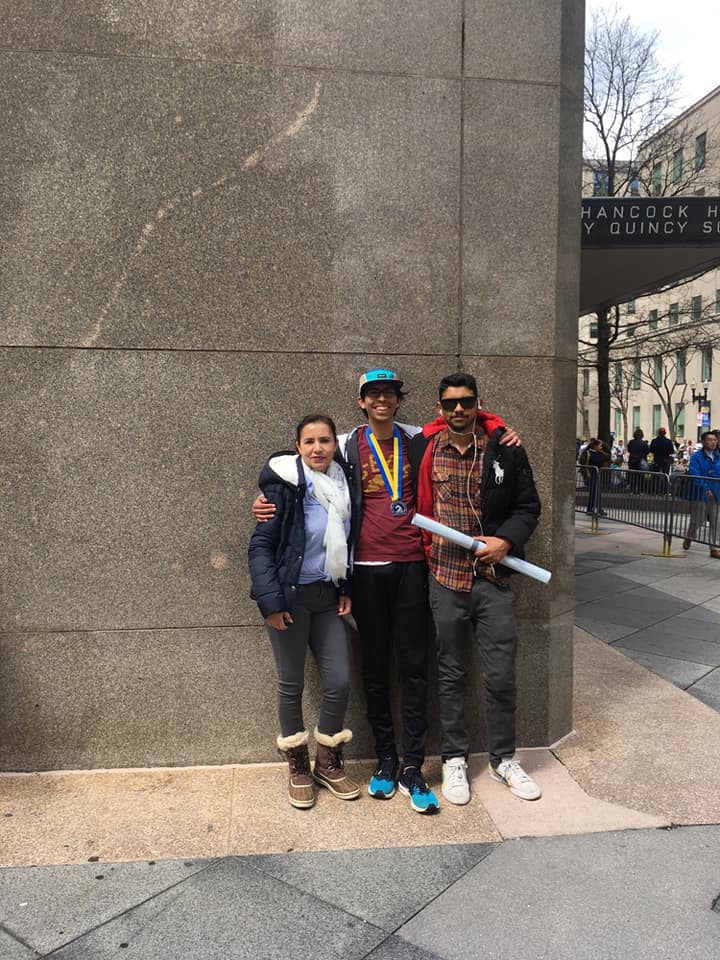
My awesome family.
Whittier and ULV reppin’ at Boston
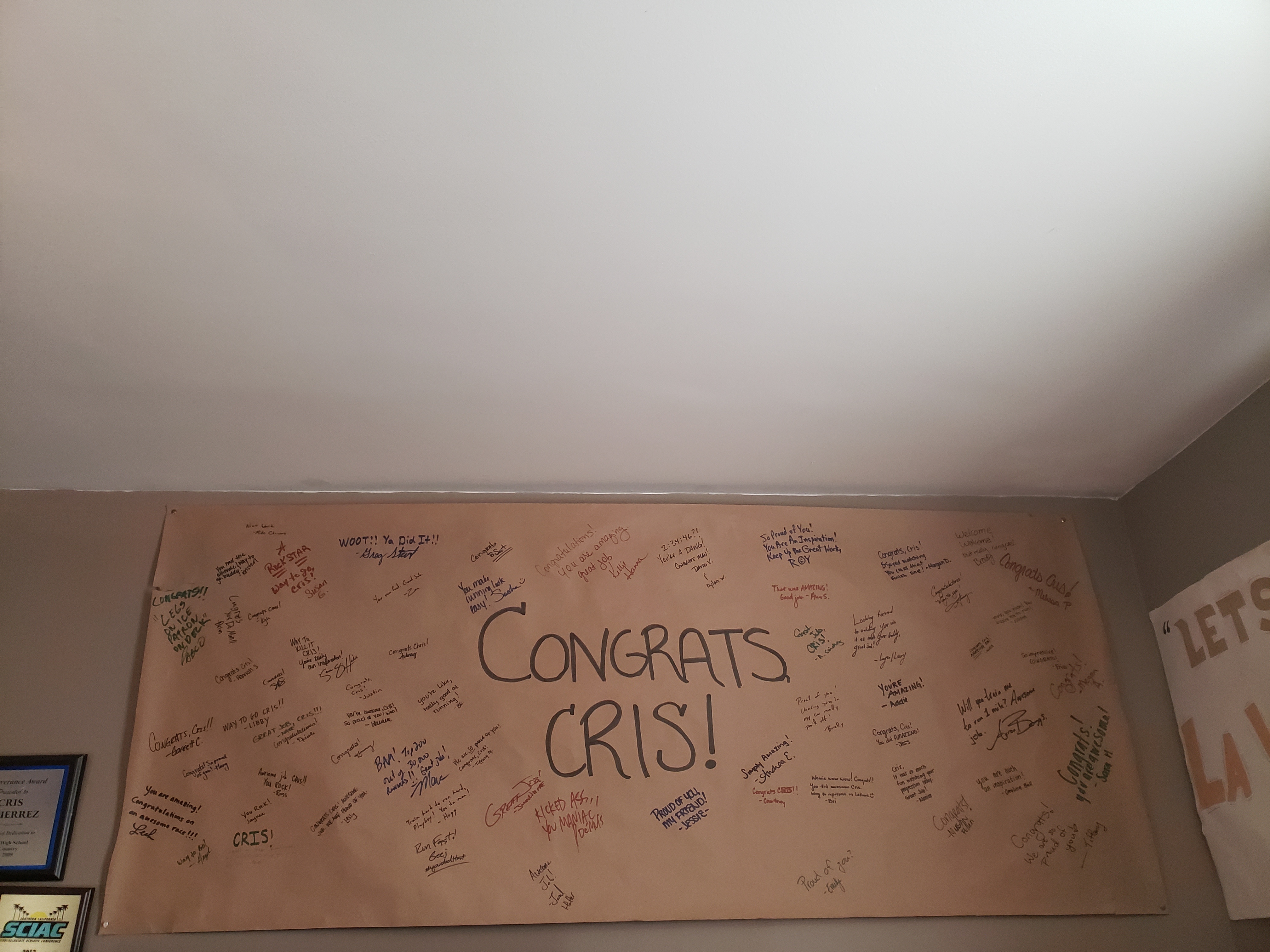
My co-workers were live streaming at work and made me this when I came back. Thanks RevLocal!
I’ve always thought of myself as a cross country and steeplechase guy but I guess it’s time for something new, it’s time to take this marathon thing seriously.
Nationwide Children’s Hospital Columbus Marathon, watch out, I’m coming for you.
Prior to running Erie, I wasn’t sure if I would actually sign up for Boston. Qualifying for it wouldn’t be an issue, I figured I’d qualify pretty easily my first shot out, but I just didn’t find myself to be all that excited about it. I didn’t consider myself a marathoner. I was essentially running Erie because I was tired of people asking me if I’d run a marathon. I was still finding trouble finding that motivation to race again and figured I’d call it quits for the marathon after one try. This wasn’t like I was trying to qualify for NCAA’s; there was no motivation to train hard for anything at this point.
I can’t say that much changed after Erie. I signed up for Boston and just said Well I qualified, why not just run it? and just figured I would just enjoy the trip. Following Club Nationals in December my mentality changed entirely. I had just come off one of the best races I’ve had in years and I was ready to take this into the new year.
I told myself, Well I qualified , why not run fast?
So I spent the last couple months training hard for my second crack at the marathon. My training began back in California over break where I took advantage of the fantastic weather and ran some of the best times over the training routes I’d been running since high school. I think I went a bit overboard back there (closing a 9 mile run in 5:06 is a bit much) but I was having fun with it. I would be backing down the pace as I ramped up my training.
The plan for this buildup would be, 70, 70, 80, 80, 90, 90, 100 with the last month and a half to tune up and add workouts.
This build up has tested my will more than I ever would have imagined. Unlike college, I didn’t have much free time to fit running into my schedule. A 45 minute commute and an 8-5 meant I had to try and fit miles in any free time that I could. This means my lunch breaks would be filled with me working out, trying to squeeze in as many miles as possible during an hour lunch break. Run during lunch, run after work, and do it all again the next day. Winter decided it wanted to make up for the nice weather we had in November and December and brought freezing temps and lots of snow that made it hard to run without slipping. I had achilles aches throughout this buildup which made running almost unbearable at times. Even when my car broke down I still managed 5 miles waiting for my tow truck to come. I literally ran quarter mile segments from my car to get my miles in for the day and tacked on 16 miles the day before a 5K to catch up for my weekly goal. None of that stopped me. Nothing was going to stop me from my goal of reaching 100.
Three days away from 100, I decided to hit the track. The plan was for 12x1K with 200 meter jog recovery. I went through my first two pretty easy. I was clicking off 5:20 pace without much effort. As I came into the second lap of the third repeat I felt a burning in my achilles. That burning changed into a stabbing pain that dismantled my stride immediately. I finished the repeat and decided to cut the workout. Walking afterwards felt fine. I changed shoes and went for a long cool down to stay on pace for my mileage goal. Shortly after starting the stabbing pain came back and I knew it was time to shut it down completely. 3 day away from and one workout takes that away. Running can be a cruel mistress.
For the last couple weeks I’ve been rehabbing my achilles and incorporating some running while I can. I had a bad flare up last week and went to see a PT who essentially told me that I had been doing all the right things and it’s not bad enough to stop running. We will continue to stay on routine while also adding some ultrasound and graston. I’m less than 30 days from Boston and my goal is to rehab and try and maintain the fitness I’ve built through this base phase of my build-up. There is a definite possibility that I could be coming into Boston with no workouts in this build-up but if that means that I’ll be able to run it healthy, it’ll be all worth it.
Thinking about it now it’s amazing how much of a 180 I’ve made. 6 months ago I wasn’t all that excited for this race and while I may be injured right now, I just came off the best 6 week stretch of my running career. More than that it’s also shown me how much I’ve grown through this sport. Had this happened in undergrad I would have been horribly depressed. I’m still frustrated but it hasn’t shaken me. I’ve come to understand that injuries come with the sport and there’s still opportunities to come out of them stronger.
I don’t know what is going to happen at Boston but I haven’t given up. I may not be able to run the 2:29.59 goal I set for myself but a PR is not off the table. I’ll absolutely take that if I can take this fitness into a great summer training block and not get sidelined like I did at Erie. We’ll get there, I’m sure.
I want to keep competing after college, I tell him.
It’s 9:00 PM and a stalled train is the only thing between me and the 20 mile stretch leading to my apartment in Tiffin, Ohio. It’s was as good a time as ever to catch up with my first college coach. I’m in the twilight of my collegiate career; after 6 years as an NCAA athlete I’m only left with a couple weeks of eligibility. Despite competing competitively for over 10 years at that point I’m not ready to be done with running. As I stare at a train that seems to be going backwards, I go on about where I feel I am at that moment in time. I’m in the best shape of my life and I feel that in the right race I could come close to knocking at the door of a national qualifier or at the very least a provisional mark for the meet. With only so many chances left and Steeplechase being such an unpredictable event, I have no intention of running anything else. I’m all in with the steeplechase. There will be no 10K track debut this year or any chances to go after a personal best in the 5K. The end of this season would mark 4 years since I had last ran a personal best in the 5K and that bothered me.
I’m going to be honest with you, very few runners PR after college, He tells me.
Once running ceases to be the main priority in one’s life, the chances of achieving optimal performance drastically decline. Whether it’s the challenges that come with a career, social life, or simply losing motivation, maintaining that level of fitness becomes increasingly tougher the further one moves from graduation. Mike knew me pretty well; my life had not revolved around running for a couple years now. I broke from a toxic mentality toward the sport years ago and no longer it as my source of happiness and self-validation. I still took it extremely serious but there was a balance. My education and career aspirations took priority for the first time in my life.
The plan was to take a break from training following my final race. This would allow my body to rest from the long season and serve as a mental break while I focused on adjusting to wherever my next home would be. From there I would build back to quality mileage before joining a local team. I figured it wouldn’t be too long to get back to running consistently and get into race shape. I would be breaking PRs in no time.
Mike’s words foreshadowed these last two years of running for me. I was back on track for the first couple of months but after an injury that winter, training went completely off the rails. Running quickly became less important to me. I was focused on other priorities, mainly my career and giving Columbus one last shot to be home. I was running a couple of times of week but other than some random spurts of good training, nothing was consistent. I had lost that sense of urgency that came with running in college. No longer did I have a team that kept me accountable or a goal to chase, I was running without purpose and it was becoming increasingly uncomfortable.
I continued to delay my return to competitive running but as time went on, the desire to run fast again began to gnaw at me. I still had a little spark somewhere in there and my competitiveness seemed to be the jumpstart I need to get back to it. I was tired of running slow and I could see others getting faster. I started feeling like a bit of an outsider with my local groups and felt like I had been all talk for the last two years. Sure, I could muscle out a 2:41 marathon but no one had seen what I could do when I actually trained consistently. More importantly, I still felt like I had some unfinished business.
Just before my marathon I was introduced to the Columbus Track Club. An upstart club established earlier in the year, I had met one of the guys randomly helping a buddy move out of his place. They were training for USATF Club Cross Country Nationals in Spokane and were trying to field a full team for the meet. I was running well at that point and applied for a spot on the team. I was sure 3 weeks was ample time to recover from the marathon and jump into an 8K to show my stuff.
Oh how naive I was.
I ended up hurting myself as a result of inconsistent training and spent all season trying to get healthy. I ran absolutely terrible in my first race for them, with one of my miles actually being slower than my average for my marathon a couple weeks prior. I felt like the guys thought I was just some scrub that wasn’t serious or decent enough to be on the team. I barely knew these guys but I felt like I let them down. So I worked to try and get healthy. My mileage was almost non-existent following that race but I put myself on a rehab regimen to completely shake the injury. I was seeing some improvements but with the post-season quickly approaching, I wondered if it was possible to make it to the finish line in one piece. The goal became to just make it to nationals healthy.
Running Log (September 10th – December 9th)
September 10: Off
September 17: 6 miles (1 day)
September 24: 17.6 miles (4 days, All-Ohio) (27:50 for 4.87 miles, 5:43 pace)
October 1: 6.7 miles (2 days)
October 8: 24 miles (3 days, Bourbon Chase)
October 15: 17.8 (5 days)
October 22: 24.5 (5 days)
October 29: 16.4 (4 days)
November 5: 28.0 (6 days) (USATF Ohio 5k) (17:05 for 3.20 miles, 5:20 pace)
November 12: 30 (5 days)
November 19: 29 (4 days) (Turkey Trot) (21:12 for 4 miles, 5:18 pace)
November 26: 36.4 (4 days) (Alumni Mile)
December 3: 45.8 (6 days) USATF Club Cross
Despite low mileage I was seeing steady improvement. The lingering injury was gone and running faster paces began to feel comfortable again. I was getting back into form but with a month to go, being fit enough to race a 10K seemed to be out of the cards. I would hope to maintain whatever mileage I was currently on and see if I could pull something decent for race day. In the meantime I would step away from all run clubs to avoid all distractions and regain my focus. It was time to find my drive again. With two weeks to go I had a small breakthrough; maybe I could do something with this season after all. The next two weeks I developed a mantra I would repeat to myself. When I felt like cutting a day short I would repeat to myself, “I’m sick of running slow”. It was working, I tapped back in. Mentally I was there; I just needed to see if my body could be too.
USATF Club Nationals
A morning shakeout, some breakfast, and we were off to the course.
Club Nationals is very different from any other cross country experience. This is very much the grassroots of our sport. No glitz or glamour here. The majority of us flew out to Washington on our own dime to do this. There’s almost a sense of purity to it all; a collection of runners from across the country still chasing those dreams of faster times, the rush of race day. I found solace watching the masters runners race; showcasing the reality that this didn’t have to end after college. The atmosphere was a jovial seriousness if that makes sense. It was as though we were all happy to be there, thankful for the opportunity to still compete. We all took time out of our schedules to run a 10K in the middle of Spokane. We were here and it was race time.
And boy what it race it was.
I had a set race plan going into this. The only other time I ran a 10K didn’t go very well so I was coming into this with a 33:45 PR. A personal best was entirely possible as long as I stayed conservative for those early miles. The last thing I wanted was for the doors to come off because I went out in 5:00 again. 5:25’s or so would get the job done and I’d sneak out of there with a new personal best.
*BANG*
The race went out hard. Over 400 runners sprinted from the line trying to find and settle into position. I held myself back, trying to avoid the excitement of the start. I felt like I was carrying the rear of the race but I stayed calm, we had a race plan. At a mile 1 we’d reevaluate and move from there but at the moment staying calm was key. A race isn’t won in the first 400 meters but it sure can be lost there.
5:06, 5:07, 5:08…
My watch sounded, 5:09 first mile. Well then, so much for 5:25s.
My position had been secured and I went through that first mile with relatively little effort. There was nothing left for me to do than to just adapt to this new pace. I had already committed to my spot, this would be my new race plan whether I liked it or now. Since I went through so quickly, I sensed that I would find people falling back in the next couple miles. The race pulled me out much faster than I wanted to; I fully expected that this was the same case for others. Those that were a little too trigger happy would move backward and that’s where I would strike.
Sure enough that is exactly what happened. From 2 miles on I started passing people, their hard breathing and straining form noticeable. People were redlining early, the effects of a pace way too hot off the gun. I remained controlled. This was exciting but we still had a long way till the chute. The real racing would come after 8K, that was the make or break. I stopped paying too much attention to my watch and focused on the next person ahead of me. Catch, hard surge, settle in, repeat. I was having fun with this, well as much fun as you can have in the middle of a hard race. As I approached mile 4, reality settled in, if I maintained I would come away here with a pretty significant personal best. I began to repeat to myself “FIGHT”. I was over half way done now. I made the decision to run this pace, to keep pushing forward. I had committed to this race, now it was time to close it out.
At mile 5 I pulled out my fastest mile of the race, 5:07. As some of the guys on the team would say, this was full send. Now it was time to hold on. Just over a mile to go and we’ll be done with this. If I held on this would be my first personal best in over 2 years. Though I wavered a bit at mile 6 (5:17), I held on as best I could and came through the 10K at 32:25 and finished the long course in 33:50. I finished with a huge PR at 10K and almost breaking my PR with an extra half mile in distance.
I finished 246 out of 425 runners in that field. This was by far the most competitive race I’ve ever been in. I was nowhere near the top of the field but that didn’t matter to me, and I feel like if you were to ask others in that race they would respond the same. This was racing at its purest form. I found my why during this race. The chase, the rush of race day, the fight to the finish, the camaraderie, this is what I missed. I fought out there and I crossed the line with a personal best. I didn’t just survive, and I proved to myself that there’s still a lot left on the table here. I want to see what I can actually do with some consistency.
Mike was right, it’s hard to keep running competitively after college, but it’s not impossible. I have a long road to go where I want to be, but why not chase it while I still can.
If I had a dollar every time I heard this I’m sure I’d be able to afford a couple pairs of Vaporfly 4%’s.
For over 12 years that question followed me throughout the entirety of my competitive running career. I heard this from friends and family that didn’t understand running. If I was running so much a day how was I not trying to do a marathon? The concept of finishing a race being the accomplishment had never been motivation. That’s not a knock on others, just for me personally, I did this because I loved racing, I loved feeling fast.
I began to hear the topic of the marathon come up more often as I joined local running clubs in the area.The majority of the people in these clubs were training for a half or a full marathon, looking to try and top an old personal best. Every so often I’d get the question asked again and at that point I had just answered with, “I don’t want to run a marathon.”The years of hearing that question had completely turned me off of it.
To me the idea of running a marathon or even running one was not anything I was interested in. When you actually have to pay for races, you begin to think about things a little differently. With the prices of marathons being significantly higher than some dinky 5K, if there wasn’t a chance to get something out of it, either through a fast time or some prize money, there just wasn’t a reason for me to run it.
Eventually that ended up changing. With a couple craft beers in me I finally decided to sign up for one. I told myself I had 3 months to get in shape for this. I was finally healed up from a bad foot injury in the winter and now I had something to motivate me to get back in shape. I set two goals for myself in this training block, I would have one 80 mile week off singles and one 20 mile long run. I was going to try to stick around 60s for the majority of the summer and focus on quality mileage.
My progression of mileage went like this:
Week of:
May 28: 19.3 miles (4 days of running)
June 4th: 19.1 miles (4 days of running)
June 11th: 21.5 miles (4 days of running)
June 18th: 9.1 miles (2 days of running)
June 25th: 15.4 miles (4 days of running)
July 2nd: 30.2 miles (5 days of running)
July 9th: 23.6 miles (5 days of running)
July 16th: 63.5 miles (7 days of running, 15.4 mile long run)
July 23rd: 18.3 miles (4 days of running)
July 30th: 70.7 miles (7 days of running, 18 mile long run)
August 6th: 27.3 miles (5 days of running, 14 mile long run)
August 13th: 80.1 miles (7 days of running, 20 mile long run)
August 20th: 23.8 miles (5 days of running)
August 27th: 31.5 miles (5 days of running, 10.1 mile long run)
September 3rd: 37.2 miles (4 days of running, marathon)
So much for quality mileage…
I struggled to get any sort of consistency in my mileage throughout this block. For the first couple of weeks I was very slow to start as I was hesitant coming back from injury. After a sub 16 3 mile effort later in June, that went away but I began to struggle putting together consistent back to back weeks of mileage. I was fine up until I hit those long runs and had a horrible time recovering. I almost passed out at the end of my 18 mile long run and followed that week running less total miles than I had in that one run. My 20 miles ended up being the best long of my life but I spent the next three weeks struggling to feel good. I had 11 miles in my legs the week leading into my first marathon. I took two days off before out of desperation. 20 miler or no 20 miler, I wasn’t ready for this.
The Race
I was extremely conservative with my first 10 miles due to my trouble the previous three weeks. I figured I’d stay around 6:30’s for 10 and then make a decision from there. Whether it was to move or to stay at that pace, once I made a decision I would have to commit to it. My race plan changed before we even got to 3. I was able to latch myself onto 6:20 pace without working hard. Aside from a quick pit stop at mile 8 for a tinkle, I was pretty much right on or under 6:20s. My legs wanted to move faster but I didn’t let myself go under 6:15. The time to commit would come. Mile 10 was soon approaching.
I pulled my headphones out of my back pocket and got ready. I had made my decision.. I had been chomping at the bit for a couple of miles already. The pace change was almost instantaneous. I was tapping on the gas a bit, just enough to satisfy that craving for a little of the fast stuff. I wanted to really let loose but a lot could happen in the last 16.2 and the last thing I wanted was to implode after 20.
Miles 10-13.1 were very much like my first three miles. I spent most of my time making sure I was right on 6:00. I would reevaluate over the next 10 miles what I wanted to do. If i felt good longer into the race I would push a little. From 16-20 the pace began to come down. Mile 17 came, 5:46. Mile 20, 5:50. This was going much easier than I thought it was going to be.
The next 4 miles weren’t too hard but just like that last 1/3rd of a 5k, I was starting to feel it. At mile 24 the real struggle began. The run for home reminded me of that last kilometer of a Steeplechase, trying to survive across each barrier with each subsequent one looking 10 feet tall. These last two miles felt like I was running through peanut butter. I could have sworn I had imploded here. There was absolutely no way I was running under 7 minutes per mile. Turns out I didn’t falter too much, I dropped back to 6:09 and 6:07 for my final two miles.
I crossed the finish line in 2:41:07. I ran a four minute negative split over my first half.
Finally done.
8th overall and third in my age group.
The Aftermath
The moment I stopped running it was as though I had someone stabbing every inch of my legs. My muscles were spasming and it was the worst pain I’ve felt after a race. I could barely move my body, with the only movement coming from every muscle in my lower body twitching in pain. I struggled to walk over the next couple of days. In my 12 years of running I had never felt so awful after a race.
The pain eventually subsided and I attempted to return back to running after a little over a week off. About 3 miles back in I felt horrible popping in the tendons behind my knee. The marathon effects continued to make running almost impossible without a pain in the same spot. Even months later the pain from that marathon still lingers. While it’s not as bad as it was then it still continues to hamper my training.
My first marathon was relatively easy. I ran well considering the little amount of training I had going into it but the key point here is my body wasn’t ready for it. A large part of being in shape is the ability to recover. The ability to recover from a run, a workout, a race, and get back on schedule without too much of problem. Consistency is what I lacked in this training block and it led to some of the hardest months of running following the marathon. almost 3 months later and I’m finally starting to run steady without any issues. Our bodies can work through much of what we put it through. There’s a limit to these things though. Consistency in training and a reasonable progression in workload allows our bodies to be ready for how taxing a race can be. A stable training block doesn’t just allow for optimal performance, it allows for our muscles to be ready for the demands that come with it.
It’s rare to see anyone without some sort of social media profile. It’s now central to our daily routine. We’re able to express ourselves to an audience of strangers around the world in an instant. Businesses can connect with consumers without them even taking a step inside. It has never been easier to reach an audience. The potential to grow a brand or business is far easier than ever before, but so is the potential for damage. Most have utilized these platforms to expand their reach and promote themselves beyond their wildest dreams; others have destroyed their work through carelessness and poor judgment.
The craft beer industry is full of opinionated people. It’s par for the course with anyone in the food or beverage industry. Social media allows consumers to document their experiences and share to friends and complete strangers. With the decline of beer-centric forums, the vast amount of the craft beer community is now sharing their experiences through social media. Opinions are no longer constrained to niche audiences; it has spread to the general public. Critiques for beers and breweries are now easily accessible, with search engines and social media platforms adjusting their algorithms to give significant weight to customer reviews. Consumers look for reviews to validate their decisions; whether it’s visiting a restaurant or making a purchase, reviews are gold for a business.
Every business owner should understand, it is impossible to make everyone happy. You can’t please all tastes or provide service instantaneously to all customers. Many variables exist in the overall experience of a customer. People are picky and as much as we would hope that customers would take into account the circumstances of their visits, this is simply not the case. We’ve all seen that person in a long line that makes a big deal out of waiting despite the staff moving quickly to help move the line along. While we may not like it, these people also have the privilege to voice their frustrations on public forums.
In this industry you’re bound to get an unfavorable review. I tell this to all of my clients; there’s simply no way to control all aspects of a customer’s experience. What can be controlled is the response to criticism. The opportunity to connect with a customer and potentially alleviate a bad situation seems like a thing most would jump at. A chance to deescalate an angry customer and possibly win them back by just being empathetic sounds like a no-brainer right?
Oh you’d be surprised.
The first week of 2018 featured two incidents in which brewery personnel harassed a customer for leaving an unfavorable review. These breweries spewed hateful and damaging allegations towards patrons that voiced their opinions. In one case a brewery resorted to homophobic slurs in retaliation to a critical review on Facebook. In another, a full staff went on the offensive and laid out damaging character accusations towards the individual that left the critique. In 72 hours we saw two breweries alienate its customer base due to their inability to respond professionally to criticism.
The beer community has become tight knit. It may disagree on most things, but it will always come together to combat horrible business practices in our industry. We may love craft beer but this community has no qualms in destroying the reputation of breweries that we find cancerous to the community we hold dear.
I understand the thought process; the majority of owners have taken a risk to build their breweries. Owners have every right to be protective of their businesses. To some, a negative review is an attack on their livelihood. Responding emotionally to a complete stranger is easy if you feel you’re being attacked. What many fail to understand is the importance of a calm and tactful response. I, like many other customers look at some of the critical reviews first. It’s fairly easy to pump your average review score through the help of friends or family. To many, critiques hold more value and the response to said critiques can be the make or break in ones choice to visit. A simple empathetic response to a negative review can sway the opinion of a potential customer.
It has become more apparent that many businesses in this industry are under the assumption that being labeled a craft brewery makes you ineligible to critiques from consumers. You may be investing your livelihood on your business but guess what, so is every other small business. Unfortunately, many breweries have developed a pompous attitude towards its offerings as though they are a gift to the industry. Many of these breweries completely discount criticism and assume that they are experts at all things related to their business. Customer reviews present a free opportunity for growth through the insight of a consumer with no ties to your business. It could provide everything from an insight in the tastes of your consumer base, possible issues in the quality of your beers, or even problems with staffing that may have gone unnoticed. Embrace criticism and utilize it as a tool to develop your business.
I stress to my clients the importance of responding to reviews. Done right it exists as a tool to promote yourself in a positive light, regardless of the type of review. I’ve seen customers change their reviews due to a positive interaction in response to the negative review. In the majority of situations where customer’s temperament remains unchanged, an empathetic response lets a potential customer know that the business cares enough to be mature and bite their tongue to criticism, warranted or not. Take a second to step back and cool off before making the mistake to make an emotionally charged response. It’s not a good look for the public to see a business berate their customers on its social media page. If you find yourself not able to do that, hire a professional to manage your reviews. Review management is marketing in itself and you are harming your business if you are not responding appropriately. Don’t be the next thread on Beertrader ISO:FT. It’s simple, don’t be a jerk.
It’s Tampa Bay Beer Week and as always, the Facebook threads are a beautiful dumpster fire that you can’t take your eyes off of. Every day seems to have some kind of release with loads of out of towners leaving their hotel rooms empty, opting instead to spend the wee hours of the morning sleeping on lawn chairs purchased right off their flights. Checking into the hotel can happen later; it’s time to for war.
Vacation
All I ever wanted
Vacation
Had to Get Away
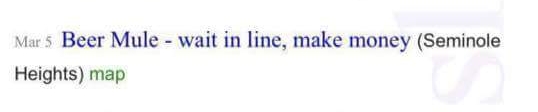
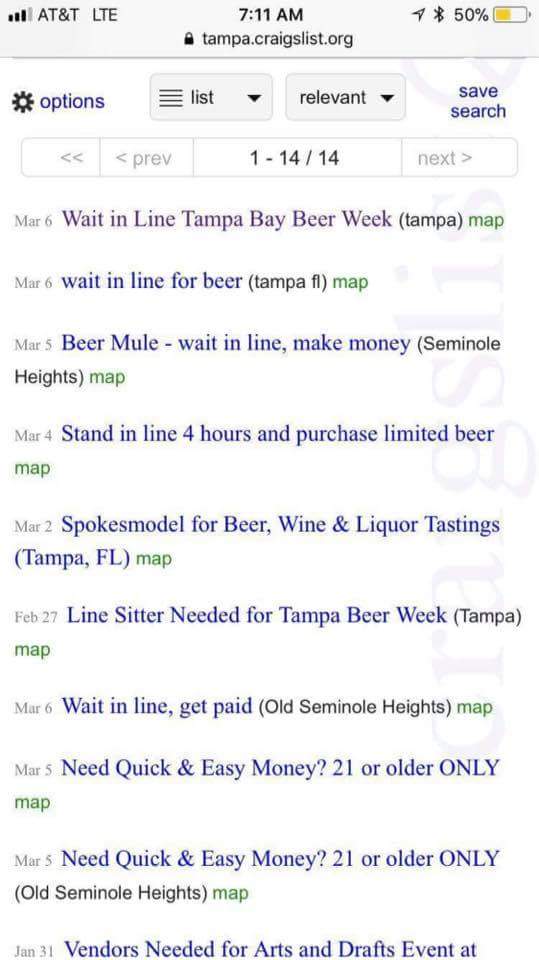
9 AM on day two. Angry Chair decides that for the sake for fairness, safety, and generally to not piss off their neighbors they are moving their bottle release from noon to 9AM. A logical choice; there are about 700 people in line already and quickly it’s getting close to being more people than beer available. Quite an interesting mix of people you have here on this Tuesday morning. The majority of the line is made up of locals and people from across the country out on vacation for Tampa Bay Beer Week and the Hunapuh Day festival. Sprinkled across the line are various people making a quick buck by standing in line for someone that solicited their services through craigslist.
Minutes go by and quickly a flood of comments come seeping through their Instagram. The vast majority of people are rather relieved to hear of this decision. The line will move through easily and people can get back to enjoying their vacation. Any reasonable human being can understand their motive; why have late stragglers stand for those extra hours if by that point bottles would be out before the last couple dozen…
Amongst the stream of encouraging comments we get our first pissed off “enthusiast”. The brewery tries to explain itself with no avail; nothing is going to convince this person that they are wrong. In their mind, all they can think about is the fact that they missed out on the beer that they deserved, despite the fact that they haven’t even had the chance to purchase it…
Screw safety and taking care of your community, I just want my beer.
This has seemingly become commonplace with each limited beer release. No matter the brewery, location, or even the style, if it’s limited you’re bound to hear people complain about beer that they feel they deserve. A quick scan of event pages or Instagram posts show the toxic dump of people losing their collective minds over losing out on the next hyped release. Regardless of what a brewery does, beer nerds are likely to find something to complain about.
Limit the allocation to three four packs a person? Bring it down to two! What are you thinking?!
Use Eventbrite or Brown Paper Tickets instead of making your customers wait hours in advanced? BOTS BOTS?! THE WEBSITE IS BROKEN!? WHY DON’T YOU MAKE IT FAIR?
Release special release beers multiple times a year? Why don’t you just make enough to have it on the shelves year around?!
If I had a sip of beer every time I read a comment with something like “Why don’t you take care of your real fans?”, I’d probably have alcohol poisoning.
Customer service is incredibly important. Consumers keep the doors open for breweries and it’s in their best interests to keep them happy. A bad experience can keep a potential loyal customer from returning to a brewery, especially in areas with much competition. For the most part, breweries do a great job making adjustments to benefit their loyal customers. Unfortunately, we are seeing consumers taking advantage of this. The craft beer “fan” of today has become entitled and has begun to use their voice to harass breweries in any situation where they feel like they did not get what they deserved. Every release becomes a time bomb; the expectation being that will be some kind of controversy because someone missed this or didn’t get enough of that.
It’s gotten out of control.
Thankfully much of these instances online have been met with a significant critical response from beer people that have been around long enough or simply don’t act like children when they don’t get what they want. This attitude is still prevalent and we must do what we can to keep this crap out of our community. You are not entitled to beer. Craft beer has been and will continue to be a luxury item. Striking out on the next it beer won’t change your life and if this means you can’t have beers with your friends at the next share, you may want to reevaluate your friend group.







 Beers and Miles